


Growth Points in The Application of Aluminum in Car Bodies
At a crucial stage in the global automotive industry's transformation towards electrification, intelligentization, and decarbonization, lightweight has become a core path to improve vehicle performance and reduce energy consumption. Aluminum, as a high-quality lightweight material with a density only one-third that of steel and a recycling rate of up to 95%, is seeing its applications expand from traditional body panels to core functional components.
The growth of automotive body sheet aluminum is not driven by a single factor, but rather by the combined effects of policy guidance, technological breakthroughs, and market demand. From a policy perspective, stringent global energy conservation and emission reduction regulations are a direct driving force. Policies such as the EU's "2035 ban on the sale of gasoline and diesel vehicles" plan and China's "dual-carbon" target are forcing automakers to reduce energy consumption through lightweight.
From a technological perspective, the maturity of processes such as integrated die casting and hot forming has solved the processing challenges of complex aluminum alloy components, while advancements in recycled aluminum technology have significantly reduced application costs. The energy consumption of recycled aluminum production is only 5% of that of primary aluminum, and carbon emissions are reduced by 95%.
From a market demand perspective, consumers are increasingly demanding higher range, handling performance, and safety features from new energy vehicles. Aluminum, however, perfectly meets these multiple requirements, including lightweight, high strength, and high thermal conductivity, making it the optimal solution for automakers.
The growing application of aluminum in automobiles is inseparable from the precise matching of alloy materials—different application scenarios have different requirements for strength, corrosion resistance, and processability, leading to significant differences in alloy selection. Currently, aluminum used in automobiles is mainly concentrated in 3-series, 5-series, 6-series, and 7-series alloys, as well as emerging aluminum-lithium alloys, forming a clear application matrix.
1. Battery Systems
Battery casings, trays, and other components require complex forming processes while resisting corrosion from battery electrolytes. Therefore, 3003 aluminum plates (easy to form, good corrosion resistance), 5083 aluminum plates (side plates, high strength and corrosion resistance), and 6061 aluminum plates (chassis trays, balancing strength and formability) are frequently chosen.
6061 aluminum alloy boasts a yield strength of up to 275 MPa and a tensile strength of 315 MPa, enabling it to withstand the weight of the battery pack and vibrations during driving while maintaining lightweight construction.
2. Body Panels and Structural Components
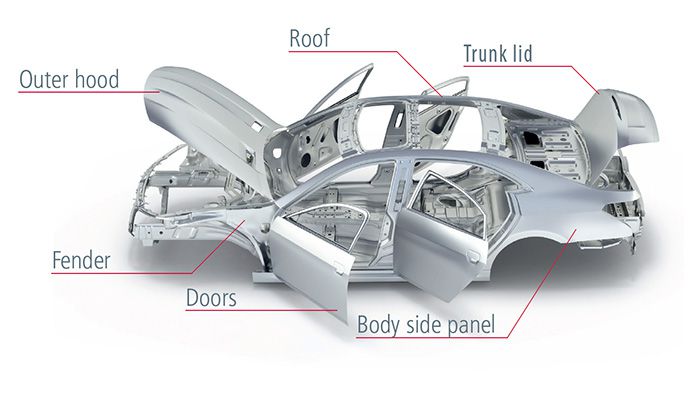
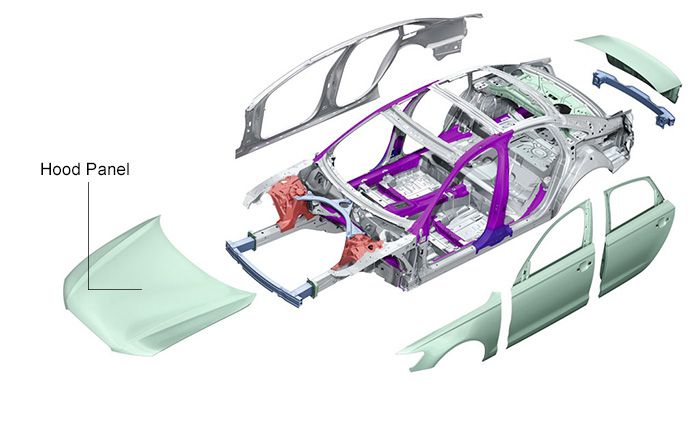
External body panels (doors, hoods, etc.) require good formability and dent resistance, making AA6016 automotive sheet the preferred choice—its tensile strength exceeds 220 MPa, and after bake hardening, the 6016 aluminum sheet’s strength can increase by another 15%, resulting in a weight reduction of over 40%.
Integrated die-cast body structural components require even higher strength and toughness, often employing 6-series and 7-series high-performance aluminum alloys. Through optimized composition and heat treatment processes, tensile strength can be increased to over 350 MPa, even approaching the level of steel.
3. Chassis Core Components
Chassis control arms, steering knuckles, and other components directly impact driving safety, requiring extremely high strength and fatigue resistaance. Therefore, 7-series aluminum alloys (such as 7075 aluminum alloy) are often chosen, with a tensile strength reaching 572 MPa, effectively reducing suspension deformation and improving handling stability. Subframes and other components can utilize 6061 aluminum alloy, ensuring strength while considering processing costs and forming difficulty.
Furthermore, aluminum-lithium alloys, as emerging materials, are gradually being applied to high-end vehicles—their density is 5% lower than ordinary aluminum, enabling a further 10%-15% weight reduction while maintaining excellent fatigue resistance, making them an important development direction for future lightweight materials.
Original Source:https://www.autoaluminumsheet.com/a/growth-points-in-the-application-of-aluminum-in-car-bodies.html
Tags: 6016 aluminum sheet ,
Prev:6111 and 6016 Aluminum Automotive Sheet
Next:5052 Aluminum Sheet for Cars
Related Product
Related Blog

Related Application
Contact Form
Products
Application

 ©
Haomei Aluminum CO., LTD..
©
Haomei Aluminum CO., LTD..